Showing posts with label outdoor masonry. Show all posts

Wednesday, March 23, 2016

Pros and Cons of Masonry Glue


http://www.theturfbarbers.com/Masonry.php
Masonry glue, also known as brick glue, masonry adhesive, construction adhesive, and landscape block adhesive, refers to a class of chemical adhesives that can often take the place of mortar in masonry construction applications.  Masonry glue is particularly useful in non -sag wall installations of exterior or interior thin brick, masonry veneer, stone, tile, and adherence of caps to masonry walls. ("Non-sag" means that a compound exhibits little or no flow when applied in vertical or inverted joints. In other words, if you are applying masonry glue to a vertical wall, it won't run down the wall.) 

Masonry glue has certain limitations. It is most useful in applications where structural integrity is not important, i.e. applying a veneer or reattaching a piece of brick or stone that has fallen down. So, for example, a mason or DIY home repairman should consult manufacturer specifications before using masonry glue in structures taller than three feet (where the compression weight begins to increase dramatically). Likewise, masonry glue can be used to hold concrete or stone products together, as in a stone walkway; however, should probably not be used in high traffic areas. Masonry glue products are often non-effective when used to adhere chemically treated wood products to a masonry face. In all such instances the manufacturer's specifications should be consulted. Landscaping glue is also not effective as a leveling agent; mortar should be used for such purposes.  

Keeping these limitations in mind, brick glue has many advantages over mortar.  Masonry glues are quick and easy to apply. They are consistent (mixed in a lab not in the field). They have reduced cleanup time, reduced labor costs, ease of transportation, no mixing (for one part adhesives), and they reach full strength in hours, not days as with mortar.  

In short, masonry glue is an effective and convenient substitute for mortar in many masonry applications, but when using the product, you should be mindful of its limitations.  

Resources: For the best in outdoor and landscape masonry in Westchester County and Putnam County, NY., call the Turf Barbers at 914 302 2469; 2929 Quinlan Street Yorktown Heights, NY 10598; http://www.theturfbarbers.com for the tops in landscape masonry and outdoor masonry.

Friday, February 12, 2016

How to Make a Water Feature Interesting

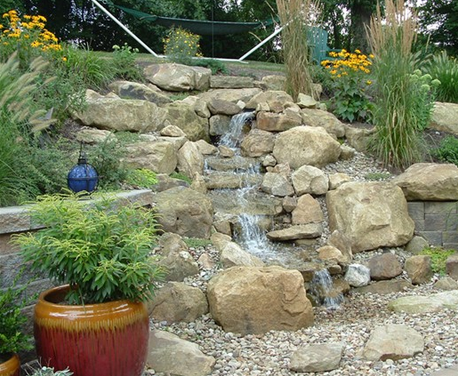
When you're placing water features on your landscape, you will do well to employ concepts used in creating the intriguing man made Lake Harris at the Mirage Casino in Las Vegas. You don't have to go out to Las Vegas to see Lake Harris. You can search for 3356 Las Vegas Boulevard South, Las Vegas on Google and then click on street view. Then take a virtual walk in a southerly direction along the sidewalk on the west side.
 
As you take the walk, you will notice that almost no section of the lake resembles another. I say almost because the landscapers have even employed the principle that sections of symmetry appearing in a random fashion (unpredictable predictability) add interest to a landscape. Lake Harris changes in  size, shape, and border on both the sides close to and far away from the pedestrians. In some places there are waterfalls that fed the lake, in others flat tropical like vegetation. On some borders there are trees, on others a small or large rock outcropping made of conjoined stone of unpredictable shapes and sizes. On one part of the far bank, there is a large uninhabited rain forest, with tropical ground cover,  bushes, and trees of various heights, shapes and species. The many waterfalls vary one from another, with falls that have three, four, five levels, or seven levels. There are narrow ribbon falls, horseshoe shaped falls that separate one section of the lake from another, and a wide semi circular falls, with intriguing rock outcroppings scattered in its lower five levels.

 When you're planning to install water features in your own backyard, consider adding variety to your lagoons, streams, and waterfalls, and their borders. You might also want to employ variety in the size shape, species, and height of your surrounding vegetation.

Resources: If you live in the Yorktown Heights, NY, Westchester County, or Putnam County area of New York State, call the Turf Barbers at 914 302 2469; 2929 Quinlan Street Yorktown Heights, NY 10598; http://www.theturfbarbers.com for the tops in water feature landscaping and outdoor masonry.


Monday, November 30, 2015

Winter Masonry


Wintertime, the night air is vibrantly crisp, and a dull white expanse of snow spreads out beneath punctuate bright stars scattered across the Heavens. This is an opportune time to sit with your family on the backyard stone patio, relax and brown marshmallows over a toasty fire brightly dancing in the outdoor chimney or fire pit.  This is a seasonal experience you don't want to miss, so contact your landscape mason ahead of time, before the first winter snows covers the last traces of green in the outdoor ground cover.  

Go over a checklist of to-dos with your contractor. Be certain your chimney and or fire-pit are clean and in good working order, fix any cracks in your patio's stone work. Enhance your backyard visual effects by trimming all summer blooming bushes (after their leaves turn), and installing outdoor lighting to give visitors the best night view of your yard's features.  Add color to your otherwise drab winterscape by putting in winter plants such as lenten roses, colored-twig dogwoods, or winter foliage conifers.     

If the snow days are still a bit off, you might be able to complete a last minute masonry project. With modern heating technology, outdoor construction companies can work all year around in most locations. Cement loses its hydration when temperatures drop below 40 degrees, but the modern mason is fully prepared to implement sophisticated winter procedures.
Outdoor builders employ a variety of techniques to keep their workers and the cement warm. This may include warming the mortar in an outdoor enclosure or enclosing the whole construction area in poly-draped work areas. Powerful propane heaters generate warm air that can be pumped throughout the site. Masons adapt cement to winter conditions by using bulk delivered dry, unfrozen ingredients, which are mixed with pre-warmed water. Type III, quick drying cement, increases the available heat.  Instead of traditional straw, stone-workers use insulating blankets, electric blankets, or heat lamps to retain the heat of cement hydration for extended periods.

Take advantage of all that your outdoor landscape and masonry can offer you to enjoy this year's winter's beauty!  

For the best in winter masonry contact the Turf Barbers. 2929 Quinlan Street Yorktown Heights, NY 10598; +1 914-302-2469; http://www.trufbarbers.com   

Tuesday, April 28, 2015

Outdoor Masonry Stone Projects


stone wall masonry Westchester County
Outdoor Stone Wall
Among outdoor masonry projects, stone work has its own unique features and creative challenges. Examples of outdoor stone work include but are not limited to outdoor chairs, stone borders, and stone walls. One thing that sets stone work apart from any other landscaping media is its uniqueness.  No two projects will turn out exactly alike, because each stone is different in size, shape, and color.  The excitement of working in stone is that you won't know exactly how the project will turn out until the last stone is fitted into its nitch. Stone work stands out from other types of hardscape because of its durability and solid functionality. An outdoor patio chair will last an average of seven years. An outdoor stone chair can last literally centuries. Stone work is also among the most sustainable forms of home improvement, especially when local rock is used. The project only requires reordering parts of the natural landscape.  
Unlike prefabricated stone masonry, which entail completing a step by step plan, outdoor stonework is a creative endeavor from start to finish. Pre-ordered stone can make lovely stone work; however, selecting stone from a local stone quarry outlet, or harvesting stone from the local environment calls for creativity as it requires attention to the color and shape of each specific stones the builder is purchasing.  Selection will go a long way towards determining the ultimate outcome of the project.  Building with outdoor stone is an equally creative undertaking. Each stone must be carefully inspected for size, shape and color. As each piece is being added, the builder must strive to fit the right stone into the right nitch. Making a stone wall is like creating an abstract painting. One wall builder might be a rank amateur, another a Jackson Pollack. Look closely at the wall pictured on the page. You will see large stones interspersed with small ones, horizontally aligned stones interspersed with vertically or diagonally placed ones.  Sections of the wall, where smaller stoned segments flow past larger stones, will draw your attention. In one segment stones are arranged in an exciting wheel like whorl. In another area, upper stones suggest an arch. No two walls are alike and no two segments of the wall are identical.
Stone work, especially involving larger stones, might be the most physically exacting part of outdoor masonry. However, at the end of the day, the homeowner or mason can rest with a sense of ultimate satisfaction. He has constructed something that will last for centuries. He has irrevocably changed the face of the landscape. A stone wall may cordon off a space for hundreds of years or more. Some historical walls are thousands of years old and draw spectators to this day.  A carpenter works with wood harvested from a tree that might be 25, 50, 100 years old, or more; whereas the stone mason uses rocks that can last for literally millions of years and bring with them an ineffable sense of the Earth's history.

In the final analysis, two unique qualities and challenges of stone masonry stand out above all the others. "Solid functionality." More than any other type of landscaping, stone masonry combines solidity with functionality. "The challenge of fitting the right stone into the right nitch." Building a stone project is an in the now creative challenge whose outcome cannot be known until the last stone is laid into place.  

For professional outdoor stone masonry in the Yorktown Heights, Westchester County area contact the Turf Barbers; 914 302 2469 ; 2929 Quinlan Street Yorktown Heights, NY 10598; 

Sunday, March 2, 2014

5 Driveway Types and Their Pluses and Minuses


(Click here to watch the different driveway types video)  
Yorktown Heights, NY Driveway
There are at least five major driveway types, as categorized by the material they're constructed from, and each one has its own pluses and minuses.

Asphalt driveways expand and contract, thereby enduring freeze-thaw cycles better than concrete. Their ability to stand up under pressure makes them earthquake resistant. Their attractive smooth surface is easy to walk on. They do require maintenance resealing every three to five years; however, they often look as good as new after the resealing.  When driveways are constructed on a sloping surface, asphalt is preferred over concrete, as concrete sits unevenly in sloping wooden forms. Because asphalt driveways do not take up moisture, water will flow into sewers and streams during and after heavy rains. This may result in toxic runoff and flooding. Asphalt absorbs sunlight and converts it into heat, which can lead to uncomfortable temperature buildups in and around cities.  

Natural stone driveways are elegant, and therefore more expensive to install and maintain. They may erode over time, especially in moist climates prone to heavy freeze-thaw cycles.  Examples of natural stone used in driveway construction include granite, limestone, and sandstone. 

Pebble or gravel driveways consist of stone chippings with or without paved areas. They're rustic looking, the least costly to install, and are often seen in a rural setting where the farmhouse has a long access driveway. They're easy to maintain and can be converted into a solid driveway if the owner wishes. They absorb water, but care should be taken to ensure proper yard drainage around their sides.  In snowy areas pebbles may be accidently removed by the snow plow during the winter and must be replaced every spring.  In rainy locales gravel driveways are prone to erosion. Driveways built on a slope are especially likely to erode.

Concrete driveways have been a favorite choice of homeowners for years. The availability of colored or decorative concrete has greatly expanded the visual possibilities of this genre of construction. Concrete driveways may be installed as open cell blocks or using pervious material, either of which will make them highly resistant to the problems of water runoff.  Concrete driveways are durable; however, they are susceptible to cracks and staining. They're cheaper to install than paver (manufactured stone) driveways, but subsequently more expensive to maintain. They are less flexible than most other driveway constructions and thus susceptible to damage from ground movements or earthquakes. Concrete driveways divert water and reflect heat, which can cause flooding and or uncomfortable temperature buildup.


Paver (manufactured stone) driveways are durable, porous, and come in a sizable assemblage of colors, shapes, and texture combinations. They may be installed as larger architectural slabs or smaller interlocking uniform parts, but only the later are suitable for car traffic.  Being composed of many smaller units, they are resistant to the impacts of weather conditions and earthquakes. They are also safe surfaces, being both skid and slip resistant. Brick pavers have all the aforementioned advantages plus they are colorfast and easy to install. In fact driveways made of brick are ready for use almost immediately after installation. Modern concrete pavers can almost perfectly imitate any natural stone look. So with pre-manufactured concrete pavers, a homeowner can create a beautiful driveway that looks like cobblestone, ancient Roman cut stone, natural brick, or more. Skillful masons engage in paver quilting, combining shapes and colors to form attractive geometric and artistic patterns.

You can see there's lots of variety to choose from when you are planning to install a driveway. Consequently, consulting with an expert is advisable. So, if you live in the Yorktown Heights, NY area or anywhere in Westchester County, be sure to call the Turf Barbers, outdoor masonry specialists, at 914 302 2469 and get answers to all your outdoor masonry questions.  


Resources; the Turf Barbers are masonry experts who buld all types of outdoor driveways in Westchester County, NY 2929 Quinlan Street Yorktown Heights, NY 10598; 914 302 2469