Monday, July 11, 2016

Tips for Buildinhg an Attractive Backyard Patio


You can build your outdoor patio ,and there are many helpful online articles that will guide you through the process. Below we have culled some of the best patio building tips from the web. 

 Before you begin to build consider these professional design tips. 

1) Build an attractive patio that is stylistically harmonious with the style of your home. Avoid automatically building your patio in a square design; odd shaped and circular shaped patios are also attractive. Especially avoid laying down a big slab outside your back door. Ask yourself what you will be using the patio for and let this suggest your shape. For example, if you will be entertaining guests on your patio, remember that people at parties like to break off into small cozy groups and then move from group to group.  So build a patio that contains intimate nooks. Also don't merely build an extension to your house. Let your outdoor patio connect with your yard's natural beauty. Steps that lead down to your lawn or outdoor water feature invite guests to intimately commune with your backyard landscaping.  
   
2)   Build your patio on a part your yard where there are no buried electrical wires or tree roots that will disrupt the stonework. Make the grade level but with a small slope that will permit the groundwater to drain away from your home. Make the hole for your patio wider than the size of the planned stonework so you create an attractive border that will support the stones and keep them in place.
3)     Every type of patio stone has its pluses and minuses. Flagstone, for example, comes in a variety of colors. A flagstone patio has narrow packed joints that allow the water to percolate down to ground level instead of running off. The finish of a flagstone patio is durable, sip resistant, and long lasting. Pavers come in a variety of colors and can be either factory manufactured or home-cut. They are relatively easy to lay out and easy to repair (just replace one broken paver at a time). Paver patios cost a bit more at the start, but have a reduced maintenance cost.
4)   If you are going to build a concrete patio, you should add a seam every 10' x 10'. An unbroken stretch of concrete larger than 10' x 10' will buckle or crack over time, usually because of the swelling and contraction of the underlying earth. Clay soils, for example, absorbs water and expands after a rain and then contracts when the weather dries.
5)    If you will be cutting your own pavers, use a cold chisel or wet saw. N cutting the stone, wear an approved dust mask or respirator (if dry cutting pavers).
6)     Keep in mind that parts of your patio construction must conform to municipal regulations. If you will be building a lattice roof, for example, the rafters (cross boards that hold the actual covering in place) and beams (side boards the rafters rest on) must be greater than a certain minimal sixe size. Consult a local landscaping company if you have any questions about your local municipal restrictions.  

Resources: For the best outdoor and landscape masonry work in Westchester County and Putnam County, NY., call the Turf Barbers at 914 302 2469; 2929 Quinlan Street Yorktown Heights, NY 10598; http://www.theturfbarbers.com for the tops in back yard landscaping.

Thursday, June 9, 2016

How to Protect Your Wood Deck


If you're planning to add a beautiful deck to your backyard, you'll want to take steps to ensure that it's beauty will last for many years.  Water, UV light, and wood destroying insects are natural enemies that will do their best to make untreated wood look terrible within 10 years. Water will rot the  wood. UV light will bleach it and give it an aged, unattractive appearance. Insects, which thrive best in a wet environment, will rot out the timber from within, weakening the  structural parts. You can take steps, however, to see that these natural disaster scenarios don't take place. 
To being with, protect your deck by using strong wood that is resistant to rot. Heartwood makes the best rot resistant decks. Redwood, Cyprus and Cedar are the wood species that most people use when they want to build a deck that will last. 
Once you've built your deck, apply a wood preservative. Wood preservatives seep into structure and protect it from insects. This class of chemicals are pesticides, so carefully follow the instructions on the label when using them. They can be toxic to humans when misapplied. 
The best defense against UV light and water is a coat of paint. However, even if you are going to paint your deck, you should still protect it underneath the first coat.  A varnish or wood seal will protect your wood against water intrusion, but the varnish will provide additional protection against UV rays. If you add paint above this protective coat, the wood will be safe as long as the paint job holds. 
If you aren't planning to paint your deck, you should add varnish or a wood seal every year. There are many inexpensive but effective wood seals and varnishes and one container will cover a wide area of the wood's surface area. 
By protecting your deck, as needed, you can keep your outdoor structure looking good for longer than 10 years. Since you or your landscaper worked hard to install the outdoor feature, you will certainly want to put in the effort to see that it looks in top condition for many years to come. If you prefer, ask your deck installer to provide the necessary upkeep and restoration for you. 

Resources: For the best in outdoor deck care in Westchester County and Putnam County, NY., call the Turf Barbers at 914 302 2469; 2929 Quinlan Street Yorktown Heights, NY 10598; http://www.theturfbarbers.com for the tops in back yard landscaping.

Wednesday, April 20, 2016

Project to Beautify Your Backyard


  You can beautify your back yard landscape by turning unsightly tree stumps into stump planters. Stump planters are tree stumps that are hollowed out, filled with soil, and then seeded. The resultant mini-garden can have any number of appearances, depending on the color of the tree stump and the types of plants that grow in the garden.   Below is a description of the essential steps you must follow to create an attractive tree stump planter:

1.    Hollow out a bowl in the wood to a depth of three to six inches depending on the type of plant you are growing. Annuals, which have shallow roots, only require three to four inches. Six inches is sufficient depth for most other plants. In most instances you should leave two to three inches of wood around the perimeter, unless you want a smaller bowl.  
2.    To make the bowl, use a pick ax (mattock), hand ax, or other sharp tool and start in the center. If the wood is soft you can use the claw end of a hammer or blunt edge of an ax to remove the material.If the wood is hard, you might consider putting some potted plants on top of the stump. Over time the water that drips from the pots will rot out the top of the stump, making it easier to hollow out.
3.    Use a hand drill or electric drill to add drain holes. Drill out and down from the bottom of the basin you have created. The holes tend to clog, so you can prevent this by adding a layer of small pebbles in the bottom of the hollowed out receptacle.

4.   An optional step you can take to improve the project is to cover the stump's bark with epoxy. This will prevent the bark from falling off, and thereby preserve the stump's natural beauty. 
5.    Now you are ready to add potting soil.  Add a mixture such as Mel mix, 1/3 Vermiculite, 1/3 Peat (or Coir), and 1/3 well-blended compost. The compost provides all the needed nutriments so no need to fertilize over the summer. Just add more compost as needed.
6.    Now add your choice of seeds. You can use seedlings, nursery plants, bulbs, or plain seeds.

Resources: For the best in landscaping projects in Westchester County and Putnam County, NY., call the Turf Barbers at 914 302 2469; 2929 Quinlan Street Yorktown Heights, NY 10598; http://www.theturfbarbers.com for the tops in back yard landscaping.

Wednesday, March 23, 2016

Pros and Cons of Masonry Glue


http://www.theturfbarbers.com/Masonry.php
Masonry glue, also known as brick glue, masonry adhesive, construction adhesive, and landscape block adhesive, refers to a class of chemical adhesives that can often take the place of mortar in masonry construction applications.  Masonry glue is particularly useful in non -sag wall installations of exterior or interior thin brick, masonry veneer, stone, tile, and adherence of caps to masonry walls. ("Non-sag" means that a compound exhibits little or no flow when applied in vertical or inverted joints. In other words, if you are applying masonry glue to a vertical wall, it won't run down the wall.) 

Masonry glue has certain limitations. It is most useful in applications where structural integrity is not important, i.e. applying a veneer or reattaching a piece of brick or stone that has fallen down. So, for example, a mason or DIY home repairman should consult manufacturer specifications before using masonry glue in structures taller than three feet (where the compression weight begins to increase dramatically). Likewise, masonry glue can be used to hold concrete or stone products together, as in a stone walkway; however, should probably not be used in high traffic areas. Masonry glue products are often non-effective when used to adhere chemically treated wood products to a masonry face. In all such instances the manufacturer's specifications should be consulted. Landscaping glue is also not effective as a leveling agent; mortar should be used for such purposes.  

Keeping these limitations in mind, brick glue has many advantages over mortar.  Masonry glues are quick and easy to apply. They are consistent (mixed in a lab not in the field). They have reduced cleanup time, reduced labor costs, ease of transportation, no mixing (for one part adhesives), and they reach full strength in hours, not days as with mortar.  

In short, masonry glue is an effective and convenient substitute for mortar in many masonry applications, but when using the product, you should be mindful of its limitations.  

Resources: For the best in outdoor and landscape masonry in Westchester County and Putnam County, NY., call the Turf Barbers at 914 302 2469; 2929 Quinlan Street Yorktown Heights, NY 10598; http://www.theturfbarbers.com for the tops in landscape masonry and outdoor masonry.

Friday, February 12, 2016

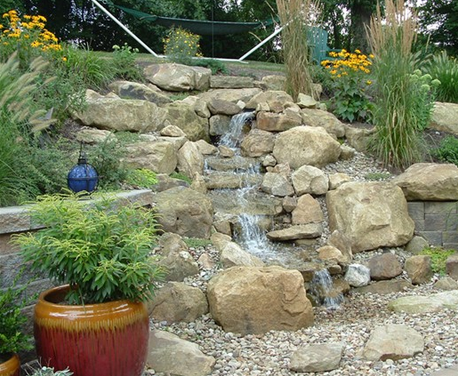
How to Make a Water Feature Interesting

When you're placing water features on your landscape, you will do well to employ concepts used in creating the intriguing man made Lake Harris at the Mirage Casino in Las Vegas. You don't have to go out to Las Vegas to see Lake Harris. You can search for 3356 Las Vegas Boulevard South, Las Vegas on Google and then click on street view. Then take a virtual walk in a southerly direction along the sidewalk on the west side.
 
As you take the walk, you will notice that almost no section of the lake resembles another. I say almost because the landscapers have even employed the principle that sections of symmetry appearing in a random fashion (unpredictable predictability) add interest to a landscape. Lake Harris changes in  size, shape, and border on both the sides close to and far away from the pedestrians. In some places there are waterfalls that fed the lake, in others flat tropical like vegetation. On some borders there are trees, on others a small or large rock outcropping made of conjoined stone of unpredictable shapes and sizes. On one part of the far bank, there is a large uninhabited rain forest, with tropical ground cover,  bushes, and trees of various heights, shapes and species. The many waterfalls vary one from another, with falls that have three, four, five levels, or seven levels. There are narrow ribbon falls, horseshoe shaped falls that separate one section of the lake from another, and a wide semi circular falls, with intriguing rock outcroppings scattered in its lower five levels.

 When you're planning to install water features in your own backyard, consider adding variety to your lagoons, streams, and waterfalls, and their borders. You might also want to employ variety in the size shape, species, and height of your surrounding vegetation.

Resources: If you live in the Yorktown Heights, NY, Westchester County, or Putnam County area of New York State, call the Turf Barbers at 914 302 2469; 2929 Quinlan Street Yorktown Heights, NY 10598; http://www.theturfbarbers.com for the tops in water feature landscaping and outdoor masonry.